
0.00 грн.
CheckoutApple Juice: Taste, Types, Canning for Winter, and Ways to Enjoy It
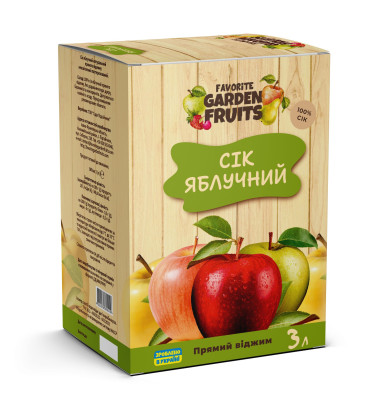
We combine the apple varieties for our juice after measuring their sugar and acidity, so the juice comes out neither too sweet nor too sour. The apples grow in our orchard, and the 3 L bag-in-box with a tap holds nothing but not-from-concentrate (NFC) juice. Its taste is balanced, like a juicy fall apple, and every variety in it plays its own part. This same juice is also the base of all our other juices, from cherry to pumpkin.
Contents
- The taste of apple juice: a honey note and freshness
- Brix, acidity, and blending: what the taste depends on
- Renet Symyrenka and 900 varieties in Mliiv
- Juice color: clarified, unclarified, and why apples turn brown
- Apples that don’t sink: how we make the juice
- Ingredients and nutritional value
- How to make apple juice and can it for winter
- Mulled wine, baked apples, and cabbage: 3 ideas
- Frequently asked questions
The taste of apple juice: a honey note and freshness
The taste brings together the honey note of sweet varieties and the freshness of sweet-tart ones, and neither dominates. The acid behind that freshness, malic acid, takes its name from the apple itself (Latin malum): in 1785, the Swedish chemist Scheele first isolated it from apple juice.
Brix, acidity, and blending: what the taste depends on
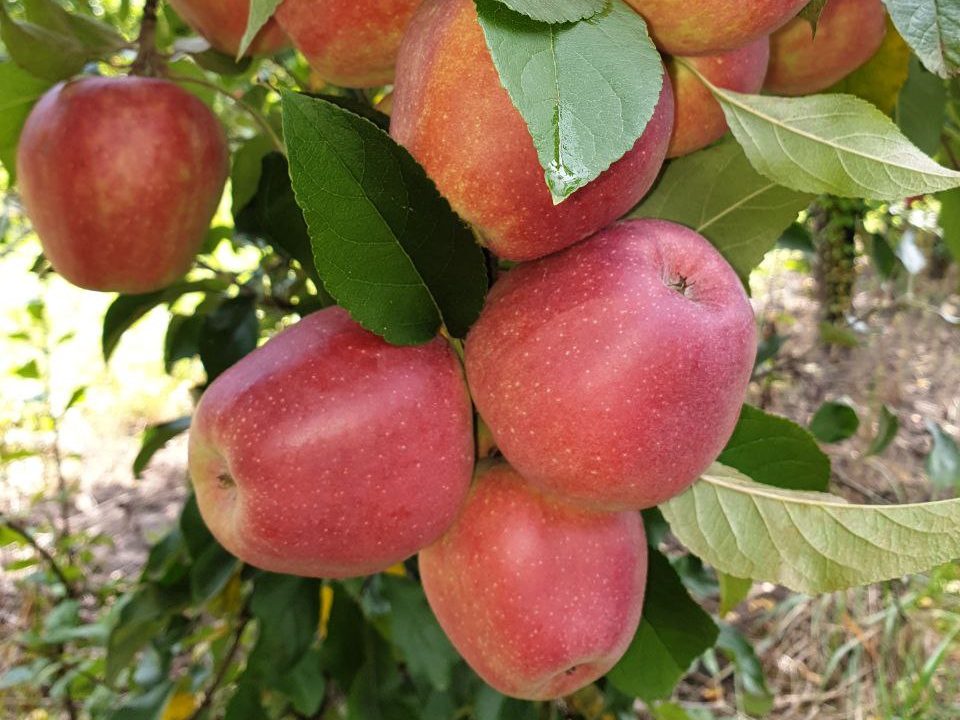
The taste of apple juice rests on two things: sugar and acid. Sweetness is measured in degrees Brix (°Bx): a refractometer shows the amount of dissolved solids in the juice, mostly sugars, and 12 °Bx is roughly 12 g per 100 g of juice. The tartness comes mainly from malic acid; juice contains 3 to 11 g of acids per liter, depending on the variety.
But the taste depends not on each number separately but on their ratio: Brix divided by acidity in percent. When the ratio is below 15, the juice tastes sour; when it is above 45, too sweet. In a study by Poland’s National Institute of Horticultural Research (Skierniewice), tasters usually rated juices with a ratio above 17 more highly.
Varieties differ greatly in these numbers. Here are three from that study — direct-pressed juice, averaged over three seasons:
| Variety | Brix, °Bx | Acids, g/L | Ratio |
|---|---|---|---|
| Antonovka | 10.0 | 10.4 | 9.7 — sour |
| Topaz | 13.8 | 7.8 | 17.7 — balanced |
| Champion | 13.4 | 3.1 | 43 — sweet, little tartness |
That is why apple juice is usually made as a blend of several varieties: tart ones bring freshness, sweet ones bring mellowness. Apples lose acidity as they ripen and sit in storage, so after a few weeks the same variety already tastes sweeter. We don’t put our blend together at random: we measure Brix and acidity and use these numbers to choose the proportions of the varieties from our orchard.
There is also single-variety juice, made from just one variety. It calls for an apple whose sugar and acid are already in balance:
- Topaz is a scab-resistant Czech variety: it is high in sugar and has a distinct tartness. In Germany and Austria it is made into single-variety direct-pressed juices, and Polish researchers recommend Topaz for commercial orchards that grow apples for juice.
- Idared is sweet-tart and also makes a decent single-variety juice, pleasantly tangy.
Sweet Gala, Fuji, and similar varieties, on the other hand, have little tartness: juice made from them alone comes out flat and too sweet. They go into blends for sweetness and aroma.
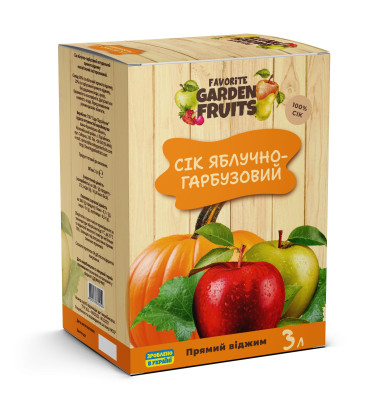
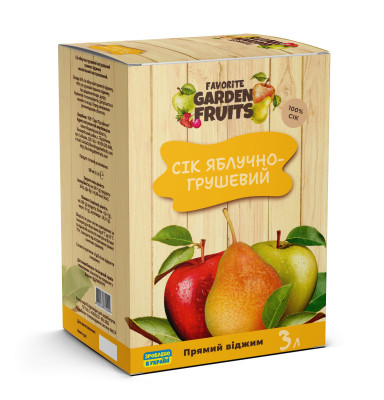
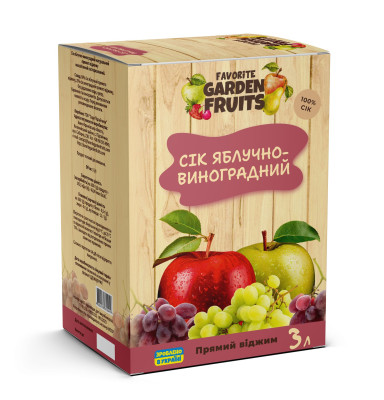
In our blends, we add 10 to 40% juice from other fruits to the apple juice. Here, too, the apple balances the taste: it softens tart cherry and freshens low-acid pear. Each flavor has its own article: pumpkin, grape, carrot, beetroot, cherry, pear, plum, strawberry, raspberry, and blackcurrant.
Renet Symyrenka and 900 varieties in Mliiv
Nobody bred Ukraine’s best-known apple variety. Levko Symyrenko noticed this apple tree in the orchard of his father, Platon Symyrenko, near Mliiv and named the variety in his honor. At the Kharkiv Agricultural Exhibition of 1887, he presented these apples as “P. F. Symyrenko’s Green Renet.” Where the tree itself came from — an old forgotten variety or a chance seedling — Symyrenko never found out.
At the family estate in Mliiv, he gathered about 3,000 varieties of fruit, berry, and ornamental plants, 900 of them apple varieties. The Encyclopedia of Modern Ukraine calls this collection one of the richest pomological collections in Europe.
Juice color: clarified, unclarified, and why apples turn brown
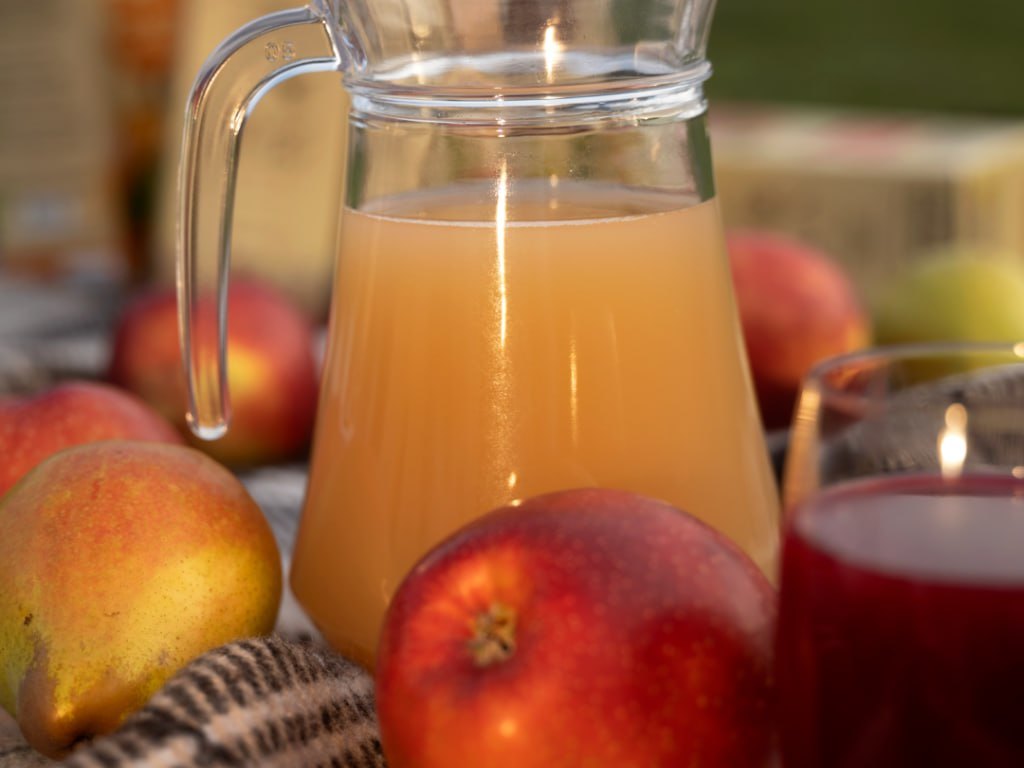
Clarified apple juice is filtered and treated so that no fine fruit particles remain — it is clear and pale gold. In unclarified juice these particles stay, and its taste and aroma are usually fuller. Our juice is unclarified — that is exactly what the label says. That is not the same as juice with pulp, which has apple puree added to it.
Freshly pressed juice darkens in the air just like a cut apple. In apple cells, an enzyme and phenolic compounds are stored separately; when an apple is cut, bruised, or crushed, these “partitions” break down, and with the help of oxygen the phenolic compounds turn into brown pigments. Some varieties brown within minutes, while others stay light for a long time.
Apples that don’t sink: how we make the juice
We start by washing the apples picked in our orchard — and they don’t sink in the water: there are tiny air pockets between the cells of the flesh, and in some varieties they take up almost a third of the apple’s volume.
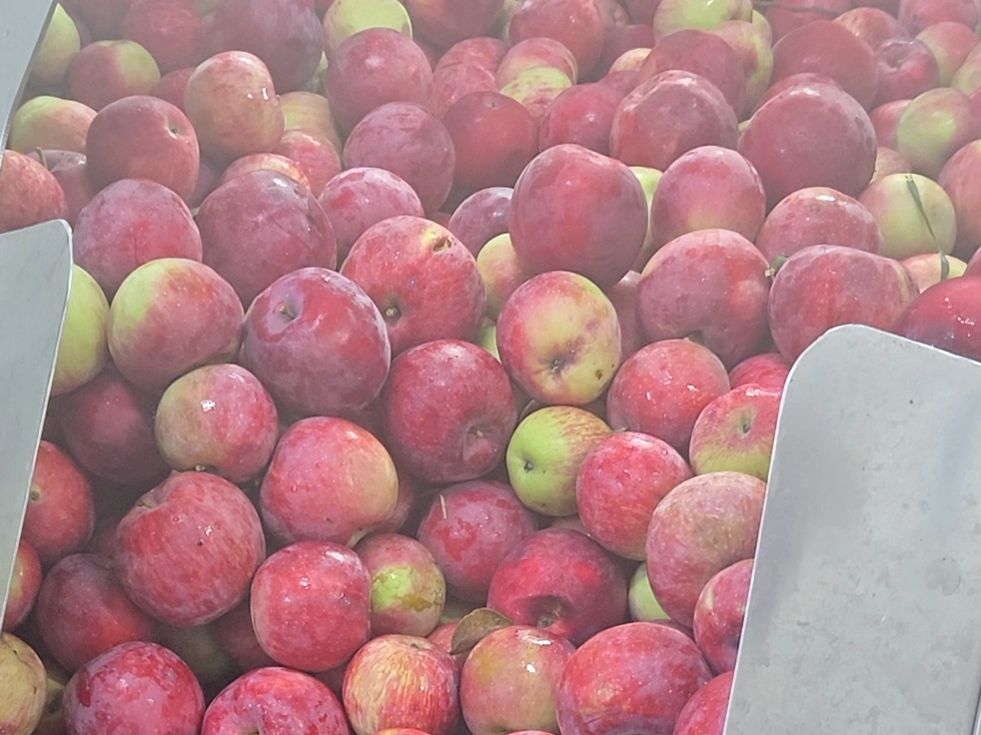
Next, we crush the apples and press them on a belt press: a liter of juice takes 1.2–1.5 kg of apples. We pasteurize the juice and fill it hot into 3 L boxes with a tap (Bag-in-Box).
Ingredients and nutritional value
There is only one ingredient: direct-pressed apple juice, not reconstituted from concentrate.
| Per 100 g of juice | Amount |
|---|---|
| Energy | 167.4 kJ / 40 kcal |
| Protein | 0.5 g |
| Fat | 0 g |
| Carbohydrates | 9.5 g |
For comparison, apple nectar may be only half juice or puree. How nectar falls short of direct-pressed juice is explained in a separate article on nectar and reconstituted juice.
How to make apple juice and can it for winter
Homemade apple juice is made on the same principle as ours: press, heat, and pour while hot.
- Wash the apples, cut out any damaged spots, and cut them into quarters.
- Press the juice with a juicer or a press, or extract it in a steam juicer. Add a little lemon juice to the freshly pressed juice right away so that it darkens less.
- Heat the juice to 90–95 °C, almost to a boil, and don’t boil it for long: prolonged boiling gives it a “cooked” taste.
- Pour the juice hot into sterilized jars, seal them, turn them upside down, and leave them to cool.
When you have no apples of your own or no time for jars, it is easier to get ready-made juice in a bag-in-box with a tap.
Mulled wine, baked apples, and cabbage: 3 ideas
1. Non-alcoholic mulled wine
Heat the juice with cinnamon, cloves, ginger, and orange until it starts to steam, without bringing it to a boil, and let it steep under a lid. Our article “Non-Alcoholic Mulled Wine Made with Direct-Pressed Juice: 4 Recipes” gives proportions for 1 and 3 L and three more recipes.
2. Baked apples
Core 4 apples without cutting through to the bottom, and put a teaspoon of chopped walnuts with a pinch of cinnamon into each. Place the apples in a baking dish, pour in 150 ml of juice, and bake at 180 °C for about half an hour, basting the apples twice with the juice from the dish.
3. Red cabbage braised in apple juice
Shred half a small head of red cabbage, chop an onion, and fry everything in oil for 5 minutes. Pour in a glass of juice, add salt, and braise covered for about 40 minutes. The cabbage will turn soft and sweet-and-sour — a side dish for potatoes or buckwheat.
Frequently asked questions about apple juice
Added sugar: zero — sugar is not added to juice. The sweetness comes from the apples themselves: fruit juices contain only naturally occurring sugars, and our juice has 9.5 g of carbohydrates per 100 g. In homemade recipes for winter, sugar is optional, usually 1–3 tablespoons per liter.
“Yabluchnyi”: that is the word for things made from apples — juice, pie, vinegar. “Yablunevyi” refers to the apple tree itself: apple blossom, an apple orchard, an apple branch.
Grate the apples on a fine grater and squeeze the pulp through cheesecloth. This yields only a little juice, so for winter jars people use a juicer, a steam juicer, or a press.
Once opened, the juice is best finished within 14 days. An unopened box keeps for 12 months in a dry, shaded place at temperatures from 0 to 25 °C.
The best way to get to know our juices is to start with apple: every other one starts with it.
You can order fresh-pressed apple juice, 3 L, on our website. The minimum order is two boxes, and you can mix flavors; all our juices are in the “Juices” section. We ship within 1–2 business days via Nova Poshta and Ukrposhta across Ukraine. Our article “Fresh Apple Juice: How We Make It” explains how we make our juices, and “Juice in a Bag-in-Box with a Tap” shows how to open the box and how long it keeps.
Order fresh-pressed apple juice →
2026-10-05 12:00:00
Comments:2
Views:3508
Comments